
BlancoByte is proud to announce a delivery partnership withSolanica, the company behind the open-source OpenEverest project. Together, we’re bringing private, self-hosted Database-as-a-Service to organizations that want cloud-era ergonomics without cloud-era trade-offs.

Public DBaaS made databases easy. It also made your data someone else’s leverage.
For a decade, the industry’s default answer to “how do we run databases?” was simple: don’t. Hand it to RDS, Cloud SQL, Atlas, or Aiven, and let someone else carry the pager.
It worked. Public DBaaS gave teams one-click provisioning, automated backups, painless upgrades, and elastic scaling. It set the bar for what a database experience should feel like.
But it came with a quieter set of costs that are now impossible to ignore:
Data residency became a contract clause, not a guarantee. Your data lives where your provider’s regions live, under your provider’s jurisdiction. For banks, insurers, healthcare providers, and public-sector organizations, “trust us” is no longer an acceptable compliance posture.
Egress fees became a tax on your own data. Moving data out — for analytics, for AI training, for migration — costs real money. The more value your data has, the more expensive it is to use it anywhere else.
Vendor lock-in became leverage. Proprietary extensions, opaque pricing, and one-way migration paths mean your provider negotiates from strength. Every renewal cycle, you feel it.
The forces pulling databases back home
Three macro trends are converging to make self-operated databases not just viable again, but strategically necessary:
1. Regulated industries are tightening, not loosening
Financial services, healthcare, and government workloads increasingly require demonstrable control over where data sits, who can access it, and under which legal regime. Auditors are asking harder questions, and “it’s in the cloud provider’s compliance PDF” is a weaker answer every year.
2. Sovereign-cloud mandates in Europe and the Middle East
From the EU’s push for digital sovereignty to national cloud initiatives across the Gulf, governments are mandating that critical data stay within national borders — and often within nationally controlled infrastructure. Hyperscaler “sovereign” offerings help, but many organizations are concluding that true sovereignty means operating the data layer themselves.
3. AI changed the gravity of data
Training, fine-tuning, and retrieval-augmented generation all want compute next to the data. Shipping terabytes across egress-metered boundaries to feed GPU clusters is slow and expensive. Vector databases, inference endpoints, and the transactional systems feeding them increasingly need to live in the same private network — under one operational model.
The catch: nobody wants 2012-era database operations back
Here’s the honest problem. Teams left self-hosting for a reason. Hand-rolled backup scripts, white-knuckle upgrades, snowflake configurations per engine, and 3 a.m. failovers are exactly what public DBaaS rescued us from.
The question isn’t “should we bring databases back in-house?” For a growing number of organizations, that decision is being made for them by regulators, boards, and AI roadmaps.
The question is: can you bring them back without giving up the cloud experience?
Enter OpenEverest and the Solanica Platform
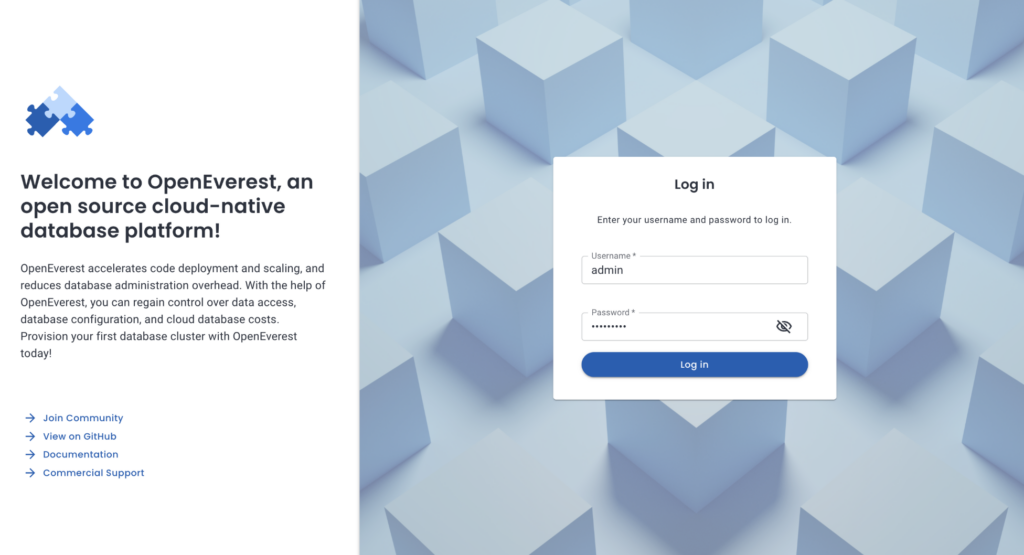
This is the gapSolanica was built to close. Solanica develops and powers OpenEverest — an open-source, CNCF Sandbox project that turns your own Kubernetes clusters into a fully fledged private DBaaS.
The model is refreshingly simple: Solanica provides the control plane; you bring the Kubernetes clusters. Whether that’s EKS, GKE, AKS, VMware vSphere Kubernetes Service, or bare metal in your own datacenter, the platform installs natively into your infrastructure, inside your network perimeter. Your data never leaves your control.
On top of that foundation, the Solanica Platform delivers the “Day 2” operations that actually make or break a database platform:
- Standardized protection — unified backup policies (S3, GCS, Azure Blob) with point-in-time recovery across your entire fleet: PostgreSQL, MySQL, MongoDB, and beyond. One policy instead of a pile of custom cron jobs.
- Fearless patching — orchestrated rolling upgrades with leader election, connection draining, and automated rollback. No more “will it come back up?” anxiety.
- Cost governance — TTLs and scale-to-zero for dev databases and GPU inference endpoints, so idle resources stop burning budget over the weekend.
- Deep observability — a pre-configured Grafana/Prometheus stack that correlates Kubernetes metrics with database internals, so you can tell the network from the disk from the bad query.
- AI-ready infrastructure — orchestration for vector databases and inference workloads with strict GPU cost controls and zero data egress, all in the same control plane as your operational databases.
In short: the self-service UX developers expect from RDS, running on infrastructure you own, with zero vendor lock-in — because the core is open source.
What this partnership brings: Solanica + BlancoByte
As of today, BlancoByte is an official Solanica reseller and delivery partner. Here’s what each side contributes — and what that means for you.
What Solanica brings
- The platform and the project. Solanica develops OpenEverest and the enterprise-grade Solanica Platform built on top of it — the control plane, the operators, the upgrade and backup machinery, the AI/vector workload orchestration.
- Product roadmap and engineering depth. Direct access to the team building the platform, with enterprise support, SLAs, and a public open-source core backed by the CNCF Sandbox process.
- Battle-tested Kubernetes data expertise. Whitepapers, reference architectures, and tooling for running production PostgreSQL, MySQL, and MongoDB on Kubernetes — anywhere — with more database engines on the roadmap.
What BlancoByte brings
- Local, hands-on delivery. Based in the Netherlands, BlancoByte provides the consultancy layer: architecture design, deployment, migration from public DBaaS, and ongoing operational support — on-premise or in your own cloud, in your time zone, under your compliance regime.
- Privacy-first data architecture. Our entire practice is built on one principle: your data stays inside boundaries you control. We design private DBaaS landscapes that satisfy auditors and regulators by construction, not by contract.
- Deep, multi-engine database expertise. BlancoByte’s practice spans operational, document, and analytical workloads — including MongoDB and Couchbase for document and distributed data, and real-time analytics powered by our ClickHouse Console and CDC Connector for streaming database changes into ClickHouse in real time. Combined with OpenEverest, this means your transactional, document, and analytical estate can run as one private, self-hosted platform.
- Migration and integration services. Assessment of your current footprint — whether you’re on AWS (RDS, DocumentDB), Google Cloud (Cloud SQL, AlloyDB), MongoDB Atlas, Couchbase Capella, or Aiven — with TCO comparison, phased migration planning, and integration with your developer workflows (Terraform, Helm, Backstage) so platform adoption feels like an upgrade, not a disruption.
What you get
A single, accountable path from “we need to get our data back under control” to a running, supported, private DBaaS:
- Assess — BlancoByte maps your current database estate across AWS, Google Cloud, MongoDB Atlas, Couchbase Capella, and Aiven, along with your compliance requirements and egress/licensing costs.
- Deploy — Solanica Platform and OpenEverest installed into your Kubernetes clusters, on your infrastructure, behind your firewall.
- Migrate — phased, low-risk movement of workloads, with CDC-based replication keeping systems in sync during transition.
- Operate — day-2 automation from the platform, expert support from BlancoByte, and product backing from Solanica.
The quiet trend, made loud
Private DBaaS isn’t a nostalgic return to racking servers. It’s the synthesis the market has been waiting for: cloud-grade ergonomics, sovereign-grade control. Regulated industries need it, sovereignty mandates demand it, and AI economics reward it.
With Solanica’s OpenEverest platform and BlancoByte’s delivery expertise, that synthesis is now something you can deploy — not just read about.
Ready to explore what a private DBaaS could look like in your organization?
📧 Reach out to BlancoByte at support@blancobyte.com or via blancobyte.com/contact-us 🔭 Learn more about the platform at solanica.io and try the open-source core at openeverest.io
BlancoByte — Private. Secure. Insightful. Solanica — The Control Plane for Your Data.